
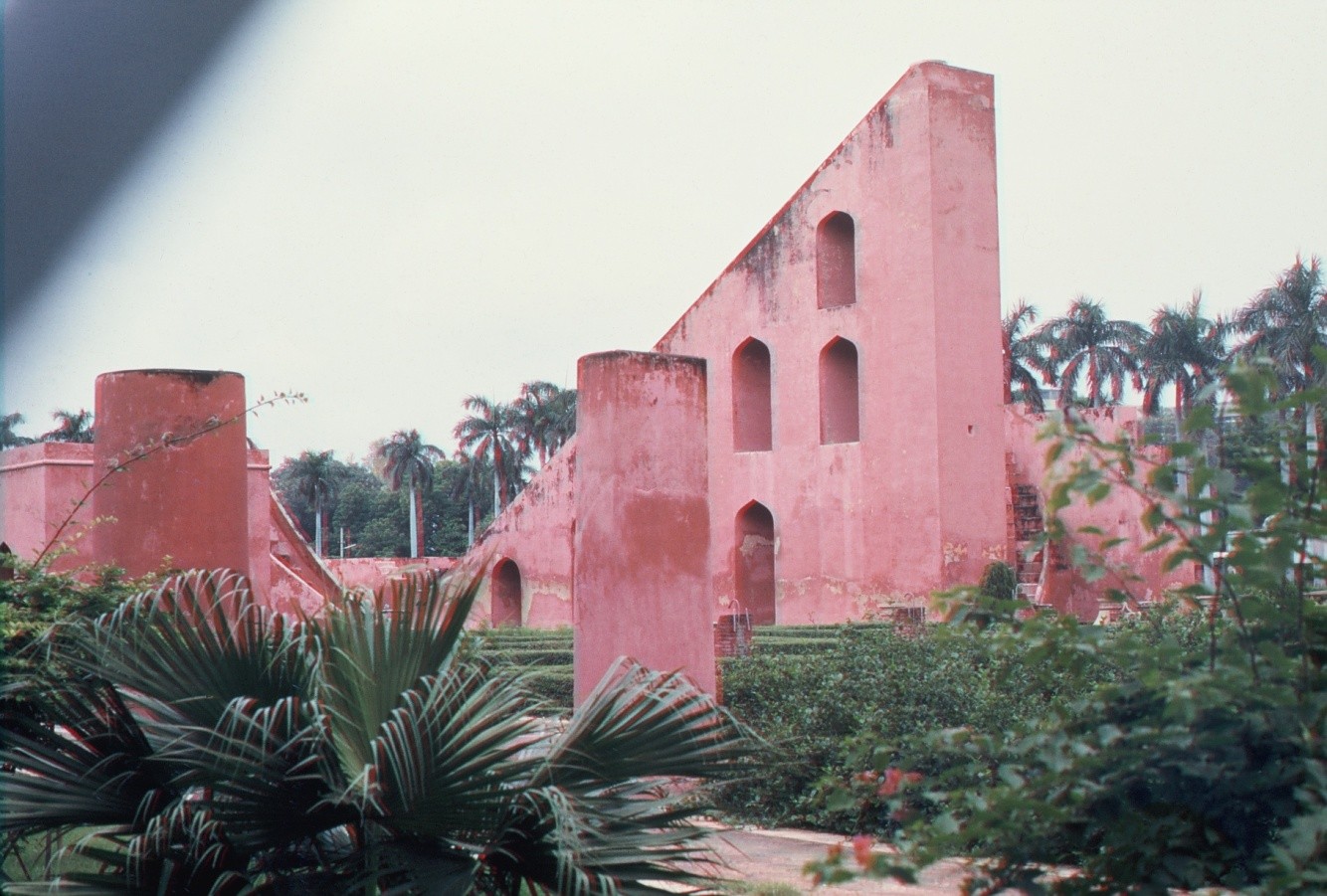
Places can be special for many reasons – memories of an important event, historical or cultural significance, or their unique qualities. Jantar Mantar is one of those places that represents all three of these for me.
When I first arrived in India, I wandered around New Delhi by myself, trying to figure out the country from this little portion of it. I took this photo to record my time there—please ignore the camera strap in the upper left corner. It’s a location that appears in India Interlude. Kevin, one of the major characters, also visits here, trying to understand this very foreign country, enthralled by these pink geometries.
Its architecture is striking, although its appearance is only part of the story. It’s an astronomical observatory, built in the eighteenth century, one of only five in the country, remarkable for their accuracy in telling time.
Recently, it has taken on a very different significance. During the last week of July, 2026 student demonstrations held here and throughout India forced the resignation of the country’s education minister. This has major implications for the national government of Prime Minister Narendra Modi. Massive protests occurred after more than twenty students died by suicide as a result of forcing millions of students to retake an important examination. The incident was a spark that ignited a firestorm of increasing frustrations with the educational system and the lack of job opportunities for young people.
Jantar Mantar now stands as a symbol of both advanced scientific achievements on the Indian subcontinent and its more modern problems.